


.jpg)
.jpg)
.jpg)
.jpg)
.jpg)
.png)


Conference production companies: 8 compared by real clients and scale

Call us

Conference production companies do more than set up microphones and projectors. The best ones own the entire event: strategy, creative, AV, staging, permitting, and hybrid streaming under one roof. The worst ones call themselves full-service and then hand you a list of subcontractors.
That gap matters more than ever. The corporate events market hit $326.6 billion in 2025, with conferences and seminars accounting for 31.35% of all corporate event spend. Bizzabo's 2026 State of Events report found that 78% of organizers call in-person conferences their most impactful marketing channel. When a third of your corporate event budget flows through one format, the wrong production partner turns that investment into a problem you end up managing yourself.
What full-service conference production companies actually cover
A production company manages the full arc of your event - starting with event strategy and ROI alignment, which shapes every decision downstream. That means AV and technical direction, scenic and stage design, speaker coaching and show calling, vendor coordination and permitting, and hybrid or virtual production infrastructure. These aren't separate services bolted together. They're one system where each piece affects the next, and strategy is what holds it together.
You might be wondering: how is that different from hiring an AV company? The difference shows up the moment something goes wrong. An AV vendor fixes equipment problems. A production company fixes event problems, because they designed the system those problems exist within. That ownership gap changes how fast your team responds under pressure.
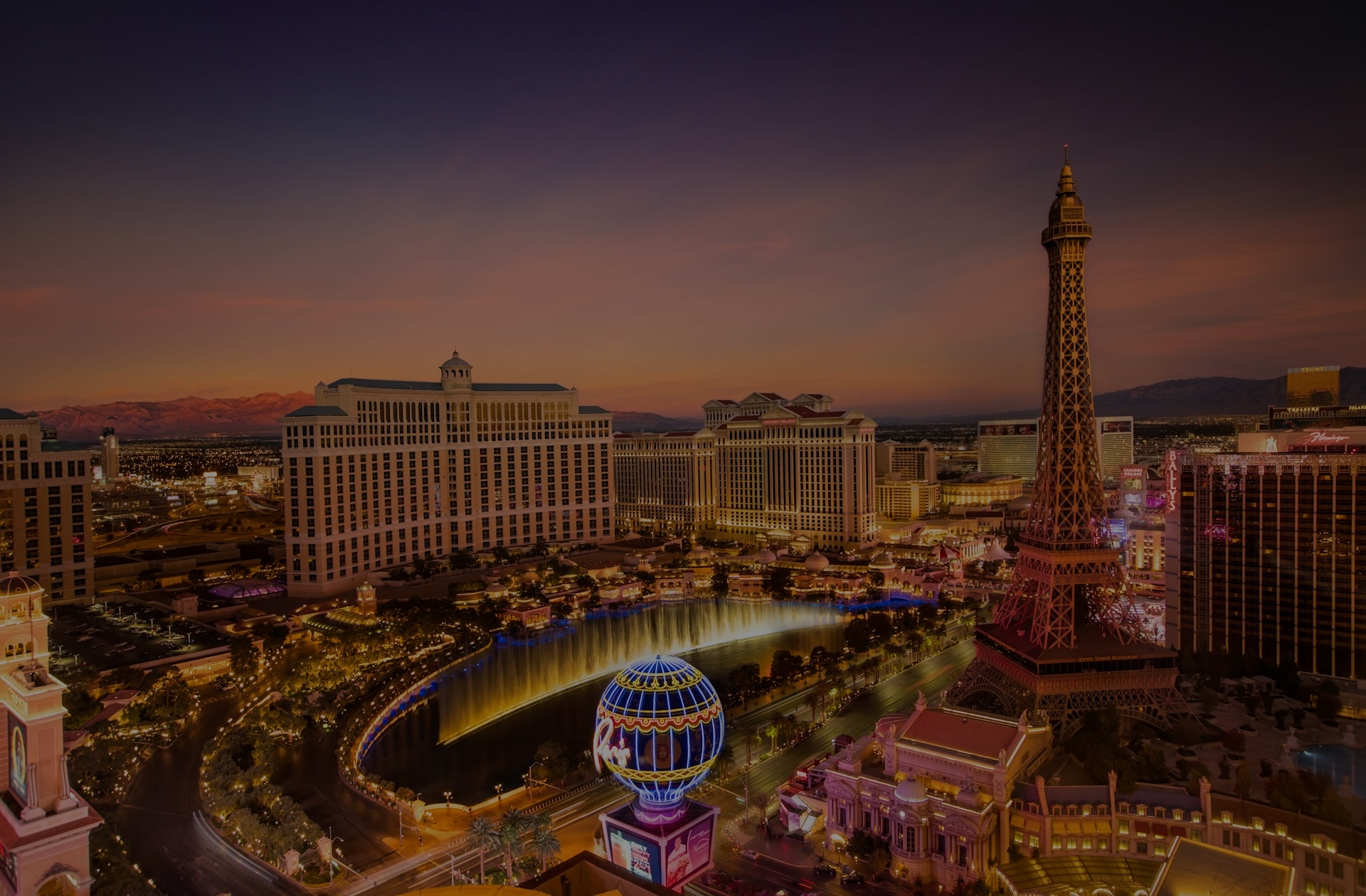
Here's what full-service looks like in practice: one production partner developed the strategy and event architecture for a cybersecurity conference in Las Vegas - then ran it for 12 consecutive years. Over that span, they managed 3D animated media, theater-in-the-round staging, 70+ breakout sessions, companion exhibits, and keynote production for heads of state, across four different venues as the event scaled. Same team, every year.
That's the standard you should be measuring against.
8 conference production companies worth evaluating this year
Each entry below gets a candid assessment: what they're known for, who they typically serve, and where their model breaks down.
VOLO Events: Emmy-winning production for Fortune 500 conferences
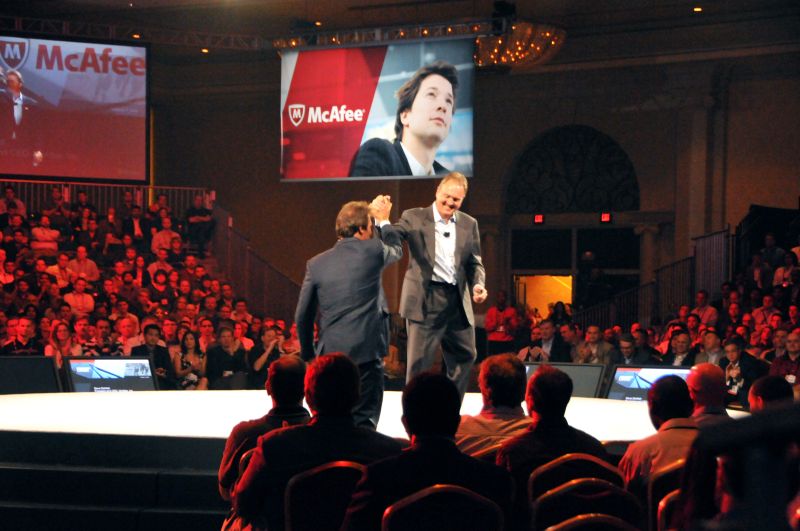
VOLO is the production company behind that 12-year cybersecurity conference. Emmy Award-winning producer Charles Marto leads the firm with 35+ years of experience. Clients include Apple, McDonald's, IBM, Intel, Delta Air Lines, Tesla, and Coca-Cola.
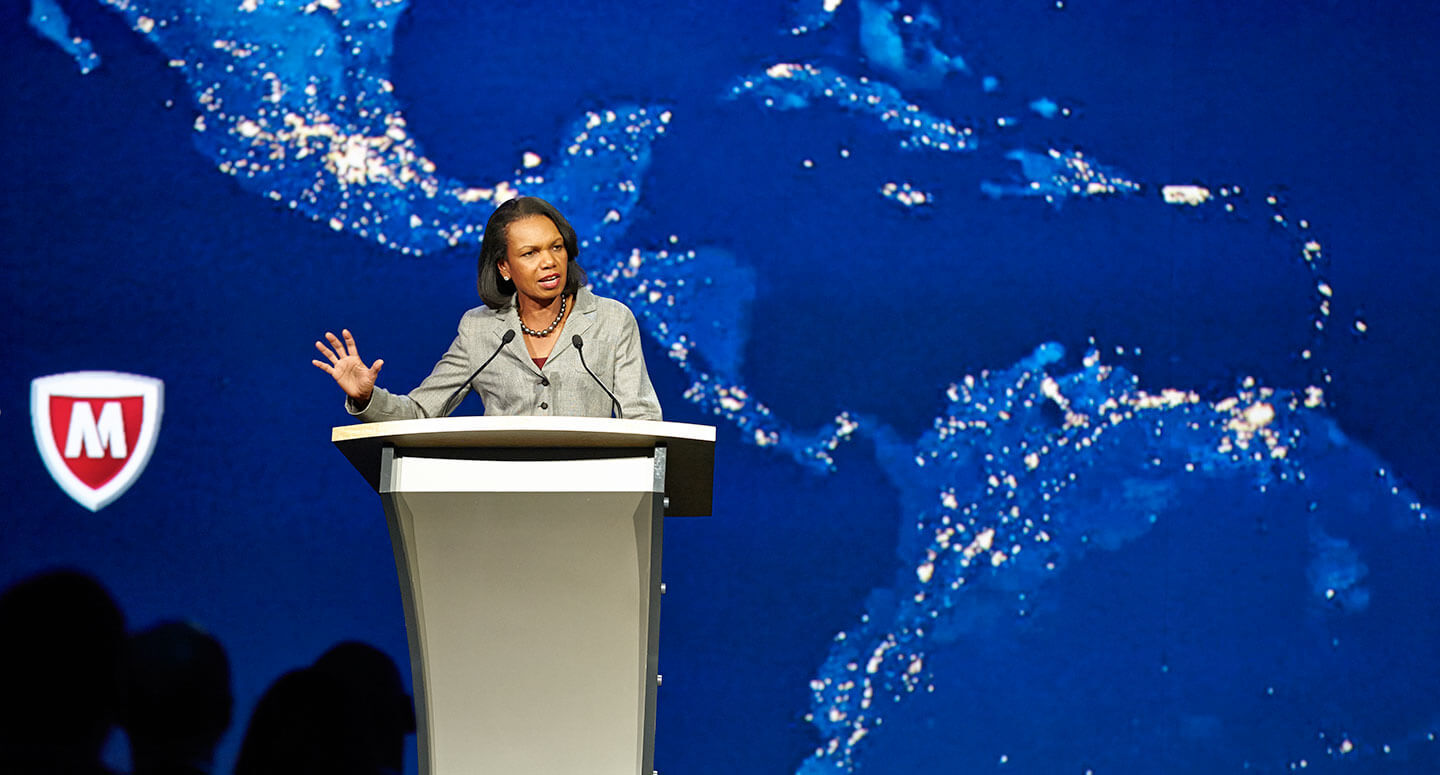
The McAfee/Intel track record tells you what you need to know. VOLO produced every year of the Focus Security Conference and its successor, the MPOWER Cybersecurity Summit, across the MGM Grand, Palazzo, Wynn, and ARIA in Las Vegas. Total attendance exceeded 39,000, including CISOs and CTOs from around the world. The team produced keynotes for President Bill Clinton, General Colin Powell, Condoleezza Rice, Sir Richard Branson, Malcolm Gladwell, and Tim Berners-Lee.
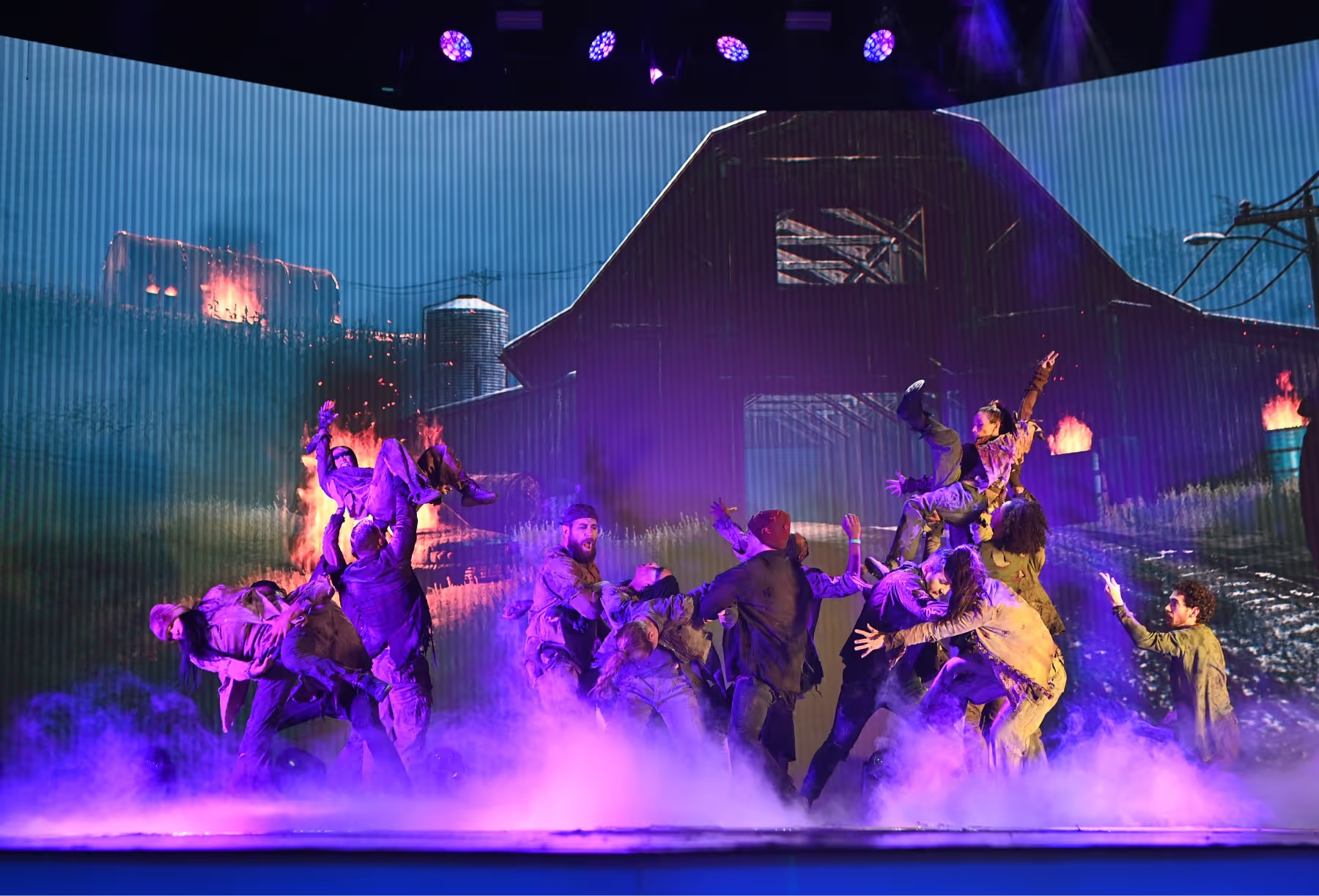
Technical scope included 18'×70' panoramic HD screens, theater-in-the-round configurations, 13M+ pixel LED environments, and full creative media production with 3D animated content for every general session.
A stunning success that led to repeat contracts over the following years due, in part, to a dramatic ROI from new and incremental business generated by the event.
That first event turned into a 12-year run. By the end of it, VOLO had helped McAfee "define its public voice, drive its brand evolution, and maintain its leadership presence through 12 years of transformation" across multiple rebrands and ownership changes.
Beyond conferences, VOLO produced Delta Air Lines' "Global Street Party" for 25,000 employees, the Coca-Cola Olympics gala featuring Celine Dion and David Foster, rapid-deployment tension fabric structures for Tesla's Fremont factory, a broadcast-level product launch for PacBio in Los Angeles, and the National Achievers Congress tour with Tony Robbins and Robert Herjavec for 11,000 attendees across two cities with 4K hologram projection.
Best for: large-scale keynotes, multi-day corporate events, and programs that need creative, AV, staging, fabrication, and show direction under one roof. Based in Las Vegas and Atlanta, produces globally.
Encore Global
Encore runs the largest installed AV network in North American hotels and convention centers. If your conference lives inside a Marriott, Hilton, or Hyatt property, Encore is likely already wired into the building. That embedded presence makes them reliable for mid-scale corporate meetings where venue-provided AV matters more than custom creative. Where it gets tricky: Encore's model depends on existing venue infrastructure.
Events that require custom scenic builds, outdoor locations, or experiential design beyond standard AV packages often need a different partner.
Freeman
Freeman brings over a century of logistics and trade show infrastructure to the table. Their warehouse network, labor pool, and exhibit management systems handle massive convention floor operations.
If your event is exhibit-heavy or trade-show-adjacent, Freeman manages operational scale that few firms match. Here's the catch: Freeman's creative and experiential capabilities don't match their operational muscle. If your conference depends on storytelling, immersive staging, or brand experience design, you'll likely want a partner that leads with creative.
Jack Morton Worldwide
Jack Morton is a design-first shop. That works if you have a locked brief and a long runway. It doesn't work if your event is moving fast, your scope is shifting, or you need a partner who adapts on the fly. The process is rigid, and you pay for that rigidity whether it serves you or not.
George P. Johnson (GPJ)
GPJ has deep roots in automotive and tech, with long-term relationships across Ford, IBM, and Google. They connect conferences to broader business goals better than most firms.
What to watch for: GPJ excels at planning depth, not fast-turnaround execution. Compressed timelines expose that gap. When you need a production team that can mobilize in weeks rather than months, GPJ's planning-first model can slow you down.
Clarity Experiences
Clarity delivers clean, dependable production for mid-size corporate meetings and leadership conferences. If you need reliable AV, project management, and on-site coordination without global agency overhead, Clarity fits well. Keep in mind: conferences that require experiential design, immersive environments, or creative media production beyond standard AV sit outside what Clarity does best.
Entire Productions
San Francisco-based, Entire handles corporate gatherings and tech-adjacent events in the Bay Area. They're a solid regional option for smaller-scale productions with quick turnarounds. The limitations are scope and geography - their operation is built for the West Coast, so national programs, large-span structures, or full-service production across multiple cities fall outside their range.
Contemporary Productions
Based in St. Louis, Contemporary handles conferences that integrate live entertainment, awards programs, and multi-day programming. Their operation centers on entertainment booking and talent integration - not full-service technical production. For conferences where AV, staging, keynote production, and event strategy carry more weight than booking acts, you'll need a partner with deeper production infrastructure.
How to compare conference production companies by scale and fit
The comparison that matters most isn't a feature checklist. It's whether a conference production company has operated at your specific scale, in your type of venue, under your kind of timeline pressure.
73% of attendees now expect modern event technology at conferences, which means hybrid capability directly affects attendee satisfaction.
If your event serves 2,000+ attendees with a general session, breakout tracks, and a hard deadline, ask for a named case study at that scale with end-to-end capabilities. If they show you a highlight reel instead, keep looking.
Here's a shortcut that saves you hours of vetting conference production companies: pay attention to the first response. If they restate your problem before pitching their services, they've done this before.
What conference production costs and why budgets vary this much
At $750K+-$1M, you're in full-service territory: custom scenic design, show calling, multi-day programming, and hybrid infrastructure. Above $1M, you're looking at premium enterprise production: custom fabrication, celebrity entertainment, multi-venue logistics, and end-to-end event strategy.
What drives the spread: custom scenic fabrication costs more than standard staging. Celebrity entertainment costs more than a local MC. Multi-city logistics cost more than a single venue. And broadcast-grade streaming costs more than a Zoom link. Each variable pushes the budget in a direction that depends entirely on your program's scope.
The McAfee Focus Conference, for example, started as a brand-new event at the MGM Grand and scaled over 12 years into a production with LED environments exceeding 13 million pixels across multiple Las Vegas venues.
The hidden cost nobody budgets for: managing fragmented vendors yourself. When your AV company doesn't talk to your scenic company, and neither coordinates with the venue's union labor rules, that coordination gap lands on your desk. A production company that owns the full scope eliminates that tax entirely.
Related projects

.jpeg)


For a 1,000-person event with a general session, breakout tracks, and a two-day program, budget varies significantly based on venue, creative scope, and hybrid requirements. Full-service production with custom scenic design, speaker coaching, and show calling typically starts in the mid-six figures. Enterprise-level productions with custom fabrication, multi-venue logistics, and celebrity programming push well past $1M. The right conference production company will give you a ballpark after a single discovery call with basic specs: attendee count, venue, dates, and program format.

Start here: Who is my day-of point of contact, and have they worked on a comparable project? What do you handle internally versus subcontract? Can you show me a production schedule from a similar event? What happens if a major element fails on-site? These five questions surface depth of experience faster than any capabilities presentation.
Ask for a case study at your scale. The best conference production companies will show you a specific event with named scope, attendee count, venue, and timeline. Check whether they manage permitting, venue coordination, and vendor logistics internally or outsource it. If the answer involves five subcontractors, you're the project manager, not them.

Let's talk
We'll be in touch over the next 48 hours

