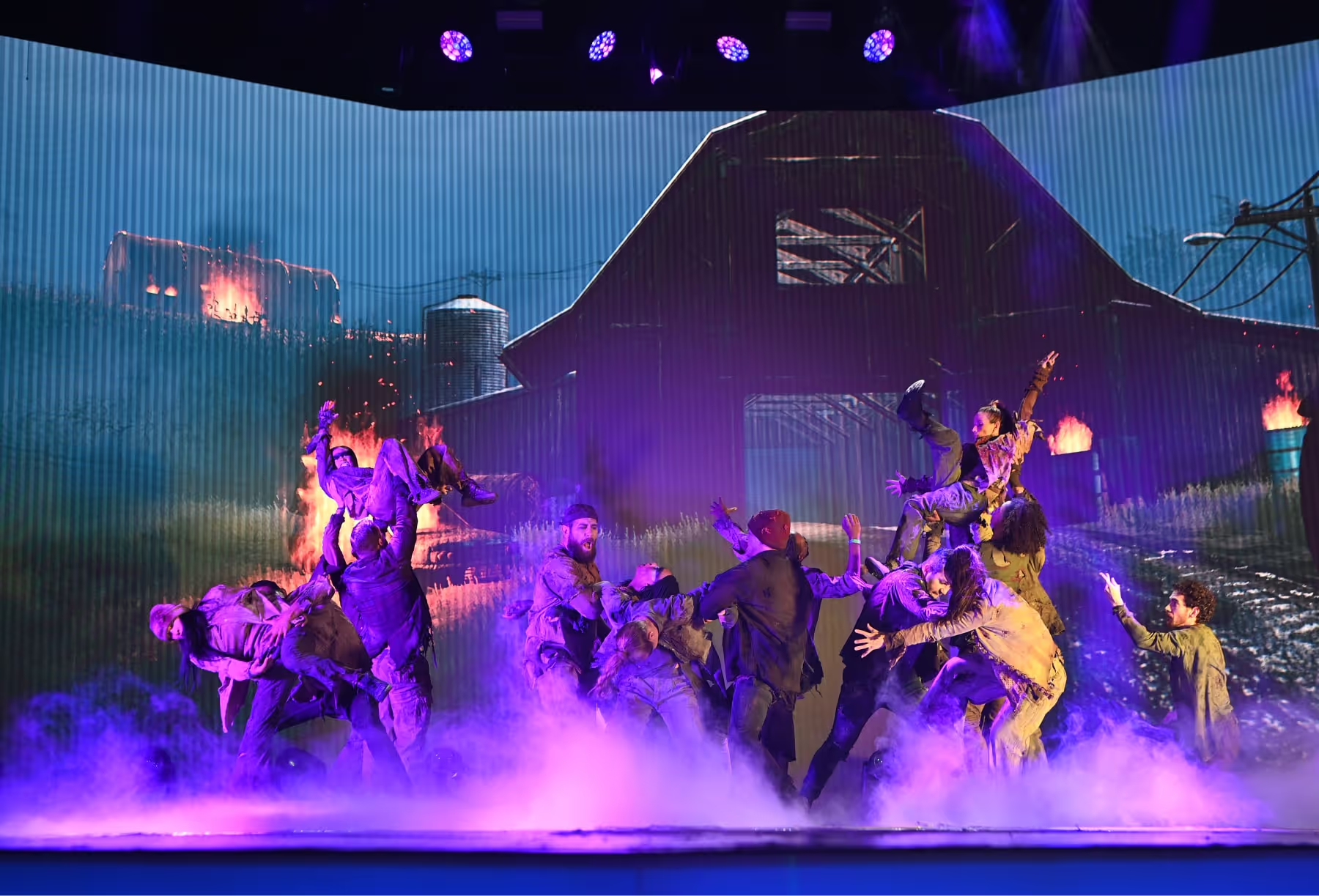
When brands ask “what’s the best agency for major event and VIP activations?” they’re usually thinking about moments where failure isn’t an option: the Olympics, the Super Bowl, global festivals, award shows, or city-wide takeovers tied to major conferences.
These environments are loud, regulated, expensive, and unforgiving. The right agency doesn’t just make things look good. It protects your brand, your budget, and your outcome.
This guide breaks down how to choose the best agency for major event and VIP activations, with practical criteria you can actually use when evaluating partners.
Define your event objectives and budget first
Before you speak to any agency, get alignment internally. High-profile activations amplify clarity just as much as they expose confusion.
Start by articulating what success looks like:
- Brand awareness and earned media
- VIP engagement or hospitality outcomes
- Lead generation or pipeline influence
- Direct sales or partnership impact
Translate those goals into SMART objectives: specific, measurable, achievable, relevant, and time-bound. For example:
- 1,500 qualified interactions over three days
- 50 VIP decision-makers hosted
- 20% lift in social reach during event week
From there, define your KPIs:
- Total event interactions
- Social amplification and media impressions
- Qualified leads captured
- Post-event sales or follow-up meetings booked
It’s also critical to set realistic financial expectations. Complex brand activations at global events often range from $400K to $2M+, depending on footprint size, fabrication, technology, staffing depth, and hospitality requirements. Knowing this upfront allows you to evaluate agencies on strategy, not sticker shock.
Event activation, in this context, means an immersive, branded experience designed to engage attendees and generate measurable promotional or commercial outcomes, not just a booth or logo placement.
Prioritize industry and vertical experience
Not all event marketing agencies are built for the same environments. Experience matters most when stakes are high.
Shortlist agencies that can prove experience in your vertical, whether that’s:
- Sports and entertainment
- Technology and B2B
- Luxury and lifestyle
- Consumer packaged goods or retail
Look for case studies tied to comparable environments: festivals, televised sporting events, or large-scale public activations. An agency that regularly operates inside controlled chaos understands permitting, crowd flow, broadcast sensitivities, sponsor restrictions, and on-site politics.
For example, agencies with proven sports and festival credentials, such as VOLO Events Agency producing activations around major league events, bring institutional knowledge that reduces risk and speeds execution.
A simple way to vet this is by comparing agency portfolios by:
- Sector focus
- Client size and type
- Event format (festival, VIP hospitality, city-wide activation)
Vertical experience is what allows an agency to anticipate cultural nuances, audience behavior, and operational constraints before they become problems.
Evaluate full-service capabilities and scalability
At the scale of the Olympics or Super Bowl, fragmentation kills momentum. The best agencies operate as full-service partners, not coordinators juggling dozens of third parties.
Key capabilities to look for:
In-house production capabilities are especially valuable. They reduce handoffs, improve quality control, and eliminate gaps between concept and execution, which is critical when activations need to scale across multiple markets or days.
Ask agencies to show:
- Examples of multi-city or multi-day activations
- Run-of-show documentation
- How they manage change control under live conditions
If an agency can’t demonstrate scalability on paper, they won’t deliver it on site.
Assess technology integration and measurement tools
Technology is no longer a “nice to have” for VIP activation agencies. It’s foundational to engagement and ROI.
Require agencies to demonstrate how they use technology for:
- Attendee tracking and engagement
- Lead capture and attribution
- Immersive storytelling
- Hybrid or broadcast extensions
Real-time analytics are especially important. These are systems that collect and surface event data while the activation is live, allowing teams to adjust staffing, flow, or programming in real time instead of post-mortem.
Must-have technologies often include:
An agency that can’t connect experience design to data will struggle to justify impact after the lights go down.
Verify staffing expertise and on-site execution
High-profile events are won or lost on the ground. Staffing is not a commodity.
The best agencies rely on experiential event staffing, not generic temp labor. Brand ambassadors, technical crews, and hospitality staff represent your brand in real time, often in front of press, partners, and executives.
Key on-site roles to confirm:
- Logistics and operations leads
- Technical supervisors and AV specialists
- Brand ambassadors trained on tone and messaging
- Security and crowd-management staff
- VIP and guest-experience managers
Whenever possible, run a pilot or trial deployment with proposed staffing teams. It’s the fastest way to validate professionalism, cultural fit, and execution quality before committing to a flagship activation.
Review vendor partnerships and production resources
Strong agencies don’t just have ideas, they have access.
Ask for transparency around:
- Preferred venue and municipality relationships
- AV, fabrication, and scenic partners
- Sustainability practices and material sourcing
- Inventory ownership vs. rentals
Agencies with established partnerships in projection mapping, AR/VR, and custom fabrication can move faster and deliver higher-quality outcomes with fewer variables. This depth matters when timelines compress or conditions change on site.
A simple vendor-category breakdown (venues, AV, fabrication, digital, staffing) will quickly reveal whether an agency is operationally deep or just well-connected.
Negotiate clear contracts
Interviews aren’t about chemistry alone, they’re about alignment and accountability.
During agency interviews:
- Review their proposed approach, not just creative ideas
- Look for customization tied to your objectives
- Ask how they handle risk, delays, and last-minute changes
Contracts should clearly define:
- Detailed scope of work (SOW)
- Milestones and timelines
- Data collection and reporting cadence
- Risk management and cancellation terms
Also request references, sample run-of-shows, and contingency plans. High-stakes activations demand clarity before money moves.
Run a pilot activation to validate fit
If the engagement is long-term or multi-market, a pilot is the smartest move you can make.
A pilot allows you to test:
- Execution quality
- Communication and decision-making
- Reporting accuracy
- Cultural alignment between teams
A simple pilot flow:
- Define scope, budget, and success metrics
- Monitor execution and data in real time
- Debrief post-event using performance data and stakeholder feedback
Use those insights to refine the master agreement and rollout strategy before scaling.
Final thought
The best agency for major event and VIP activations isn’t the one with the flashiest reel. It’s the partner that combines strategic clarity, vertical experience, full-service execution, and measurable outcomes, even when the world is watching.
If your activation lives on a global stage, choose an agency that’s already comfortable there.


.jpg)
.jpg)
.jpg)
.jpg)
.jpg)
.png)



.jpeg)